
For Mashpee homeowners, the year 2026 marks a turning point in property rights. What was once a bureaucratic hurdle—building a secondary residence on your lot—has been streamlined into a “by-right” process. However, while the state has removed the “Special Permit” requirement, Mashpee maintains a unique set of local regulations that dictate the success of your project.
The Policy Shift: What "By-Right" Means Today
On February 2, 2025, the Massachusetts Affordable Homes Act officially preempted many restrictive local zoning laws. In Mashpee, this means if your proposed ADU meets the following state and local criteria, the town must issue a building permit without a discretionary public hearing:
Size: The unit must be no larger than 900 square feet or 50% of the primary house’s living area (whichever is smaller).
The Bedroom Cap: Mashpee explicitly limits ADUs to a maximum of two bedrooms.
Rental Duration: The state allows towns to ban short-term rentals (STRs) for ADUs. Mashpee enforces a minimum 31-day rental period. The “weekend Airbnb” model is not permitted for new ADUs.
No Owner Occupancy: A major change for 2026 is that the town can no longer require you to live on the property. You can legally rent out both the main house and the ADU to long-term tenants.
Types of Accessory Dwelling Units (ADUs)
Accessory Dwelling Units (ADUs) are a versatile and increasingly popular housing solution, providing independent living spaces on the same lot as a primary, single-family home. Understanding the different forms they can take is essential for homeowners considering adding one to their property.

Detached ADU
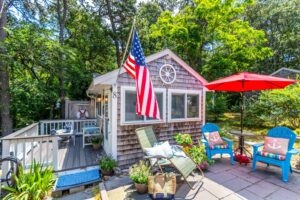
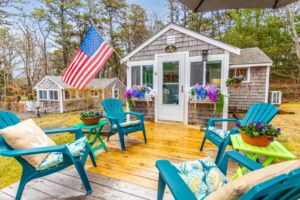
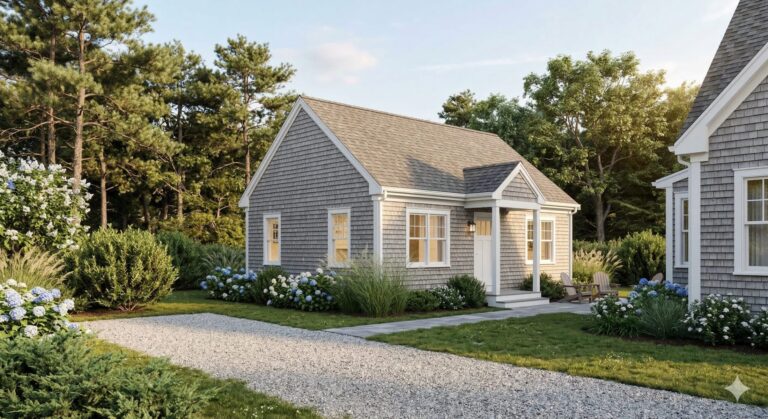
A Detached ADU is a standalone structure that is completely separate from the primary dwelling. These are often referred to as backyard cottages, guest houses, or carriage houses. They offer the most privacy of any ADU type, functioning as an entirely independent home with its own entrance, kitchen, bathroom, and living areas. Detached ADUs are ideal for creating rental income, housing extended family, or providing a private space for a home office or studio.
Key Features:
Complete Independence: Separate building, not physically connected to the main house.
Privacy: Ideal for situations where maximum separation is desired.
Backyard Placement: Typically located in the rear yard of the property.
Attached ADU
An Attached ADU is a dwelling unit that is physically connected to the primary home. This connection is typically made through an addition built onto the side or rear of the main structure. While it shares at least one wall with the main house, an Attached ADU must have its own separate, direct entrance from the outside, ensuring it functions as an independent living space. Attached ADUs can be a good option when yard space is limited or for maintaining a closer connection while still providing privacy.
Key Features:
Physical Connection: Shares at least one wall with the primary dwelling.
Separate Entrance: Must have its own exterior entrance for independence.
Streamlined Utilities: Often easier and more cost-effective to connect to existing home utilities.
Interior Conversion
An Interior Conversion ADU is created by repurposing existing space within the primary dwelling. This is common with basements, attics, or attached garages. While these units are contained entirely within the footprint of the main house, they must be converted into a complete, independent living space, including a kitchen, bathroom, and a separate entrance (which might be through a shared hallway). Interior conversions are often the most cost-effective ADU option since they don’t require new construction or foundation work.
Key Features:
Contained Within: Created from existing, unused space inside the main house.
Cost-Effective: Typically the least expensive type of ADU to develop.
Independent Living: Must still function as a complete, separate dwelling unit.
Mashpee’s Local "Reasonable Restrictions"
To be an authority in this town, you must look beyond the building permit and into Zoning Bylaw §174-45.4. Mashpee utilizes “site plan review” to maintain neighborhood character.

1. The Driveway Rule
Mashpee is famously protective of its streetscapes. The town generally prohibits new curb cuts for ADUs. This means your new unit must share the existing driveway. Expert site planning is required to ensure functional parking for both dwellings without cluttering the front yard or violating setback requirements.
2. Design Consistency
Mashpee requires that any ADU—attached or detached—be architecturally “consistent” with the primary residence. This involves matching:
Roof pitches and heights (typically capped at 25 feet).
Siding materials (e.g., cedar shingles vs. clapboard).
Window proportions and trim styles.
The Hidden Barrier: The "Septic Ceiling"
In Mashpee, the building department is only half the battle. The Board of Health is the ultimate gatekeeper. Because much of Mashpee sits within Nitrogen Sensitive Areas, your ADU’s viability is tied to your soil.

The Flow Calculation: Every bedroom adds a “design flow” of 110 gallons per day. If you add a 2-bedroom ADU to a 3-bedroom house, your septic must be rated for 550 gallons per day.
Mandatory Upgrades: If your property is within 1,000 feet of a water resource (coastal pond, lake, or wetland), adding an ADU will likely trigger a requirement to install an Innovative/Alternative (I/A) Septic System. These nitrogen-reducing systems are a prerequisite for most new ADU construction in Mashpee today.
The Expert Process: How to Succeed in Mashpee
Navigating a project in 2026 requires a three-phased approach to avoid wasted architectural fees:
The Septic Audit: Before drawing floor plans, we pull your “as-built” septic plans from Town Hall to see if your current system can support the additional bedroom count.
The Survey & Setback Check: We verify that your lot has the “envelope” to fit a detached structure while maintaining the required distance from neighbors and wetlands.
The Design-Zoning Match: We work with designers who understand the Mashpee “design consistency” rule, ensuring the permit application sails through the Building Department on the first try.